Optics × materials science × chemistry × Chinese thought · 9 min read
Why does mother-of-pearl change colour? Thin-film interference, nacre and Taiji as analogy
- Orient Qi Editorial
- Reviewed against original studies in Scientific Reports and PNAS, plus a physical-chemistry review
- Published: September 15, 2026
- Updated: September 15, 2026
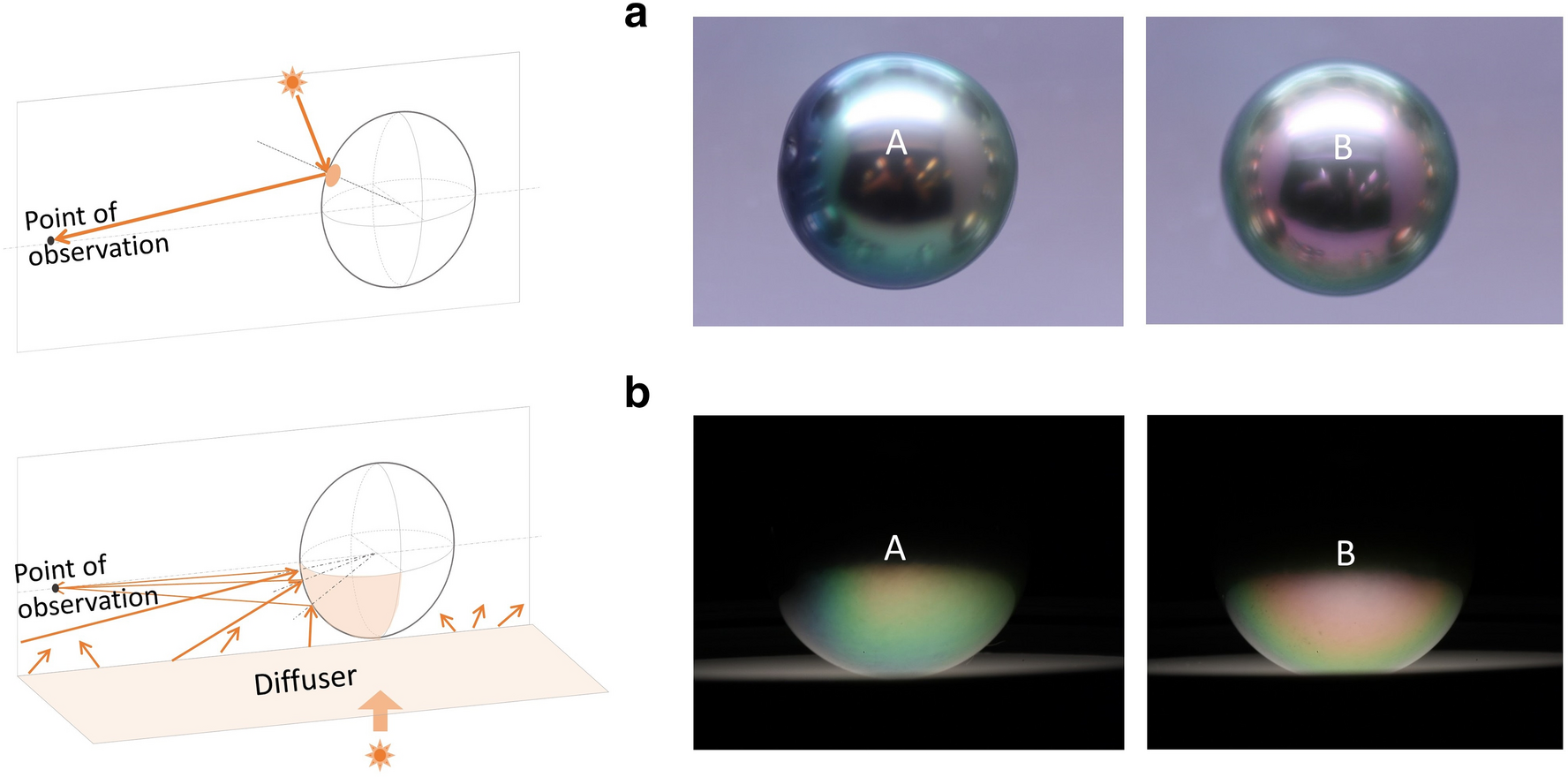
The short answer: the reinforced wavelength changes, not an energy emitted by the material
Nacre consists of many aragonite tablets—aragonite is a crystalline form of calcium carbonate—alternating with much thinner organic layers. Light reflects at many of those interfaces. Wavelengths whose path differences put them in phase become brighter while others cancel. Tilting the material changes the angle travelled inside the stack, shifting the wavelengths that receive reinforcement and producing iridescence.
01 · Colour is relational
Pigments colour mainly through selective molecular absorption; an important part of nacre's iridescence is structural colour. It depends on the periodic layers, illumination and viewing geometry, so one location can show different hues under a new angle or light.
02 · The brick-and-mortar wall approaches light's scale
Nacre is often described as a wall: aragonite tablets are the bricks and the organic matrix the mortar. Tablets in research samples are hundreds of nanometres thick, comparable with visible wavelengths and able to produce visible constructive and destructive interference.
03 · Real materials are not perfect stacks
Tablet thickness, order, surface shape and scattering vary from place to place. Species, shell region, illumination and viewing method also matter. Multilayer interference is the core framework, but it cannot reduce every natural piece's exact appearance to one number.
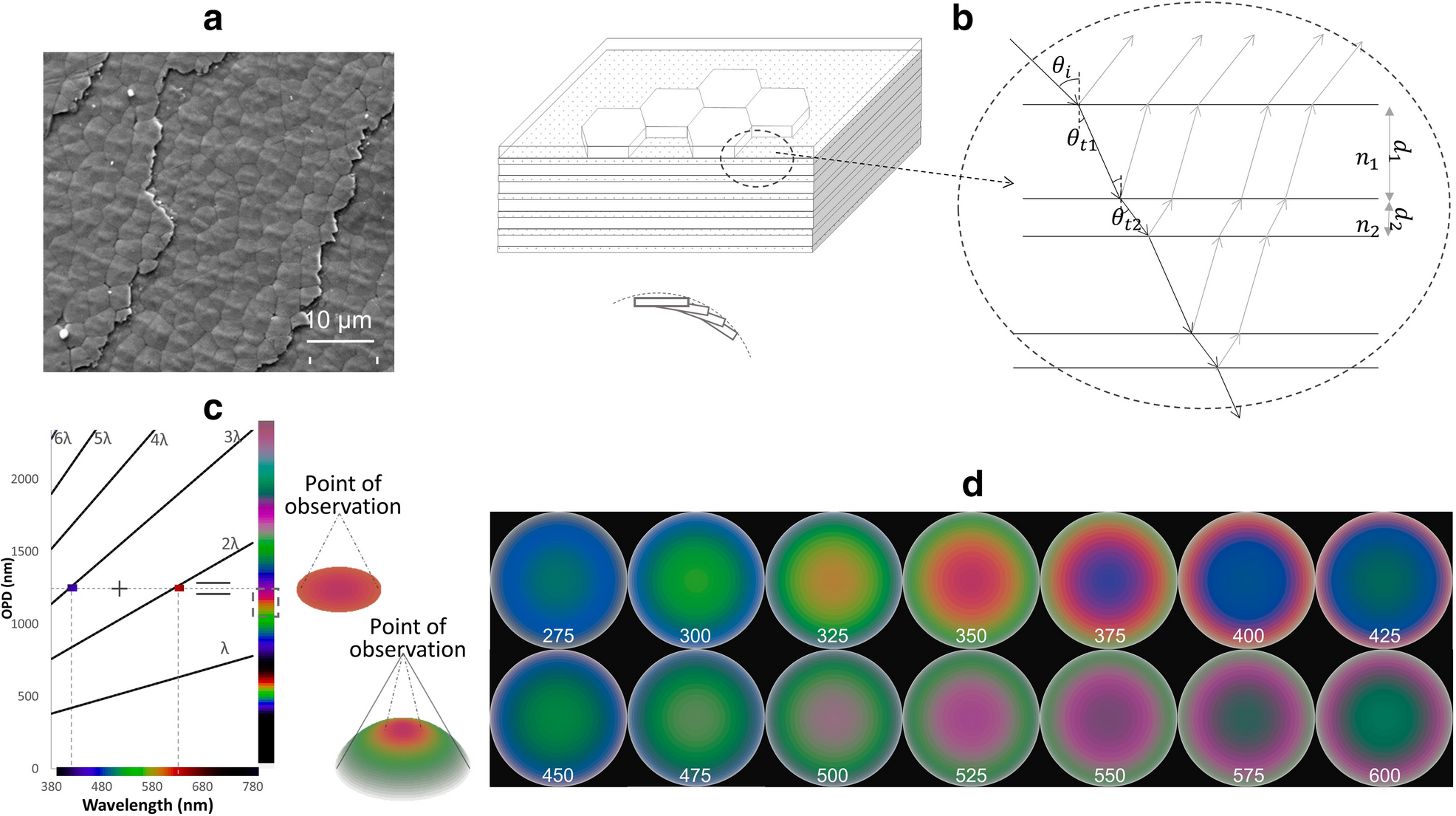
Paper Figure 1: from aragonite tablets to rings of colour
At upper left is a scanning-electron micrograph of a nacre surface. Upper right unfolds a curved surface into repeating aragonite–organic layers. Below, Bragg-like conditions estimate and simulate colour patterns for different tablet thicknesses. These models test structure–spectrum relations; they do not guarantee the colour of a real product.
Three optical relationships are enough to start
Refraction
n₀ sin θᵢ = n sin θₜApproximate constructive interference
mλ ≈ 2nd cos θₜThickness and spectral shift
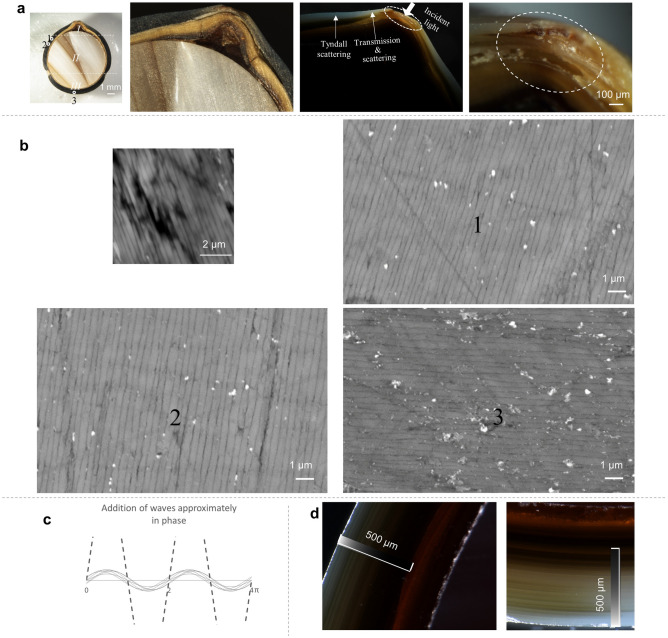
Δλ / λ ≈ Δd / dThe microscope does not reveal perfectly parallel lines
Paper Figure 4 combines the sample cross-section with optical and back-scattered-electron micrographs. Orientation and regularity vary by region, so researchers must separate specular reflection, scattering and the depth reached by light. Behind a delicate sheen sits an inverse problem with disorder, many interfaces and measurement geometry.
| Question | What the evidence supports | What it does not imply |
|---|---|---|
| Why does tilting shift the colour? | The internal angle changes the reflection peak of the multilayer interference. | It is not qi, magnetism, emotion or fate changing the colour. |
| Is every piece identical? | Natural tablet thickness, order, surface shape and scattering vary. | A paper sample cannot replace product-level material and treatment disclosure. |
| Does Taiji explain iridescence? | Taiji can be a cultural analogy for relation and change. | It is not Snell's law, a Bragg reflector or a material-identification method. |
Scientific boundary: a known mechanism does not mean every detail is settled
Multilayer interference explains the main physical origin of nacre's iridescence. Open questions include how molluscs control aragonite nucleation, orientation, growth arrest and continuation across organic sheets; how competing nucleation and mineral-bridge models work together; and how angle-dependent spectra can fully reconstruct a real, nonuniform, scattering three-dimensional structure. These are specific research gaps, not evidence for supernatural effects.
A non-destructive observation with a phone and one lamp
- Place the sample on a neutral white background and disable beauty, filter and automatic colour-enhancement modes.
- Hold phone and lamp fixed, then slowly tilt only the sample; record hue and brightness at the same point.
- Now hold the sample still and move the lamp or viewpoint; a travelling colour band is a typical structural-colour clue.
- This observes iridescence only. It cannot identify species, treatment, origin or value; consult product-level disclosure before buying.
Common questions
Does mother-of-pearl colour never fade?
That would be too strong. Structural colour does not rely on one dye, but abrasion, contamination, dehydration, adhesives, coatings and chemicals can still alter optical paths and appearance.
Does iridescence prove a material is genuine nacre?
No. Synthetic films, coatings, glass and plastics can also interfere with light; a photograph or rainbow sheen cannot authenticate a material.
Does every current Orient Qi piece contain mother-of-pearl?
Not necessarily. This is material education, not an inventory or ingredient claim; rely on the actual materials, specifications and treatment information on each product page.
What is the link between Taiji and iridescence?
Only a cultural analogy: change the relation and the appearance changes. The physical cause remains light interacting with a micro- and nanoscale layered structure.
Original research, open figures and licence
- Scientific Reports: original study of nacre nanostructure through structural-colour patterns (DOI)
- PubMed Central: open full text and Figures 1, 2 and 4
- PNAS: hyperspectral interference tomography and disorder in nacre
- Seminars in Cell & Developmental Biology: review of nacre biomineralisation and two crystal-nucleation models
- Creative Commons: CC BY 4.0 licence
Read the material facts before following the light
Orient Qi treats natural variation as part of the material and states the limits of each disclosure. When browsing ready-made pieces, rely on the material, size and care details on the specific product page; this article does not mean every item contains nacre.