ASTRONOMY × FLUID PHYSICS × MATHEMATICS × CHINESE THOUGHT · 10 MIN
Why is there a decagon at Saturn's south pole?
- Orient Qi Editorial
- Checked against the original Science Advances paper and official NASA and EHU material
- Published: September 8, 2026
- Updated: September 8, 2026
The short answer: the shapes are observed; their full cause is still open
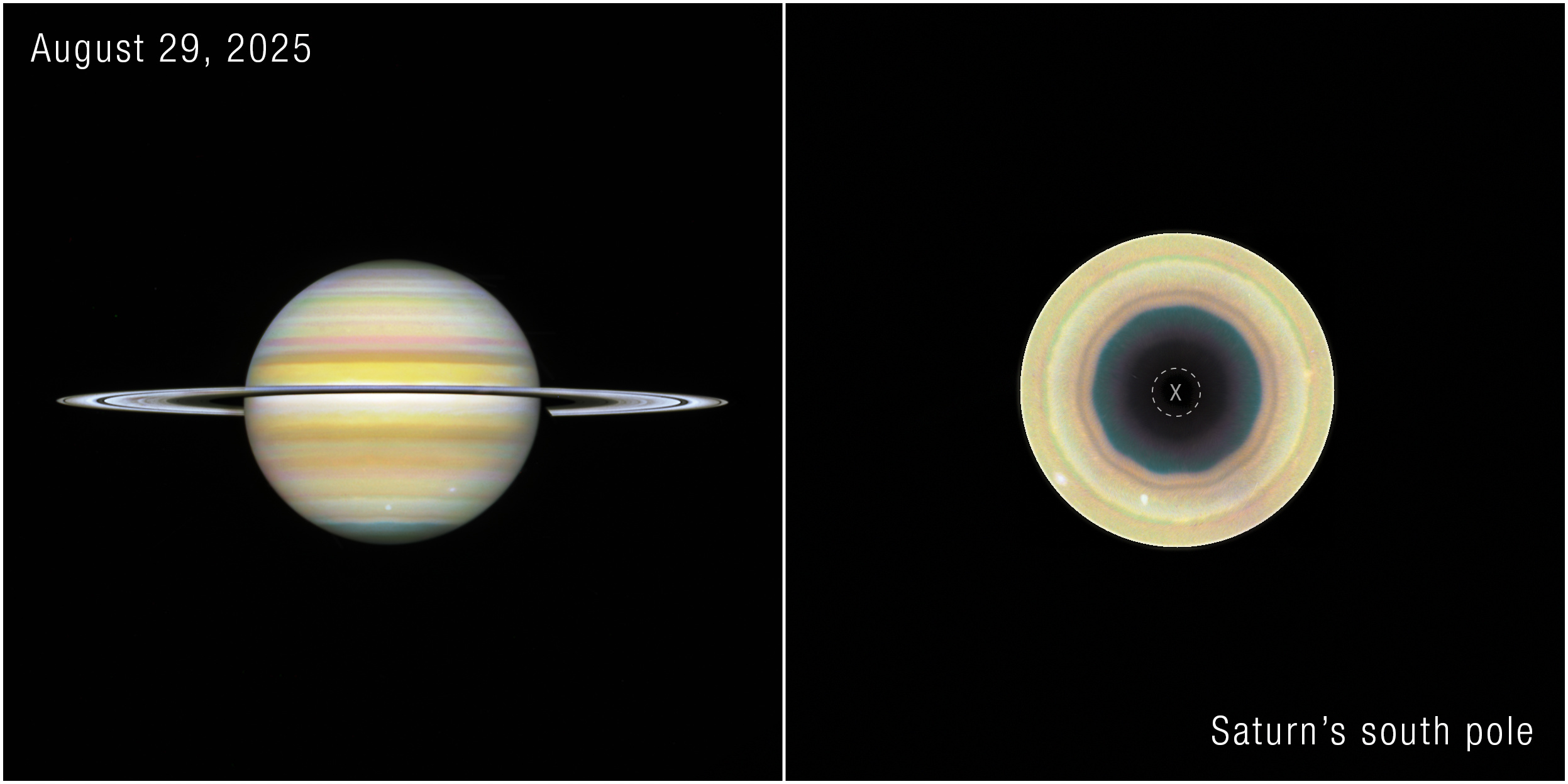
A large wave with azimuthal wave number 10 has become increasingly visible near the southern jet since 2023, while the north hosts a long-lived wave-number-six jet. Jet instability, Rossby waves and deep rotating convection are plausible mechanisms, but no single model yet reproduces every detail of shape, speed, vertical depth and persistence. A scientific unknown is a specific model gap, not evidence for a supernatural answer.
01 · Decagon: a southern wave in development
Hubble's OPAL observations identify the first large, persistent, regular-sided jet pattern in Saturn's southern hemisphere. The research team reports a jet near 400 km/h while the whole decagon drifts at roughly 10 km/h; its vertices oscillate on a period of about 32 days.
02 · Hexagon: four decades of northern weather
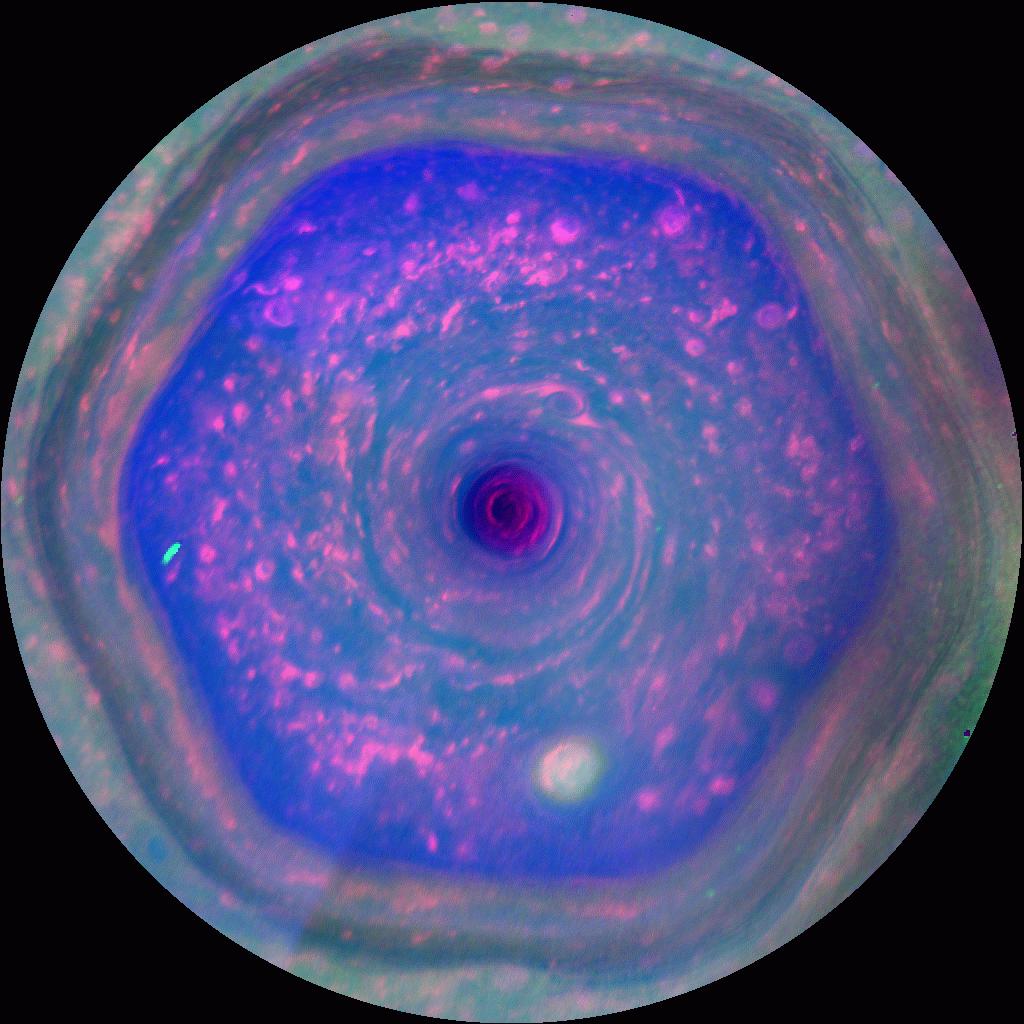
Voyager supplied the early evidence and Cassini the defining views. It is not a solid frame but a wave-shaped polar jet. Infrared observations indicate structure below the visible cloud tops. Its longevity is established; why a sixfold mode is selected so stably has no unique answer.
03 · Polygon: a standing pattern around a circle
A disturbance repeated m times around the pole has azimuthal wave number m. Six repetitions make m = 6; ten make m = 10. Seemingly straight sides are the projected outline of peaks and troughs, not crystalline clouds.
One planet, two geometries: north six and south ten
Cassini's polar view shows a central vortex and smaller vortices inside the hexagon. A fast jet behaves like a circular track; shear against slower flow can select and amplify a wave. Rotating-tank experiments and simulations generate polygons under different parameters. Producing a polygon, however, is not the same as reproducing Saturn.
Four expressions for sides, rotation and waves
Sixfold mode
m = 6 → 360° / 6 = 60°Tenfold mode
m = 10 → 360° / 10 = 36°Shallow-water potential vorticity
q = (ζ + f) / hSimplified Rossby-wave speed
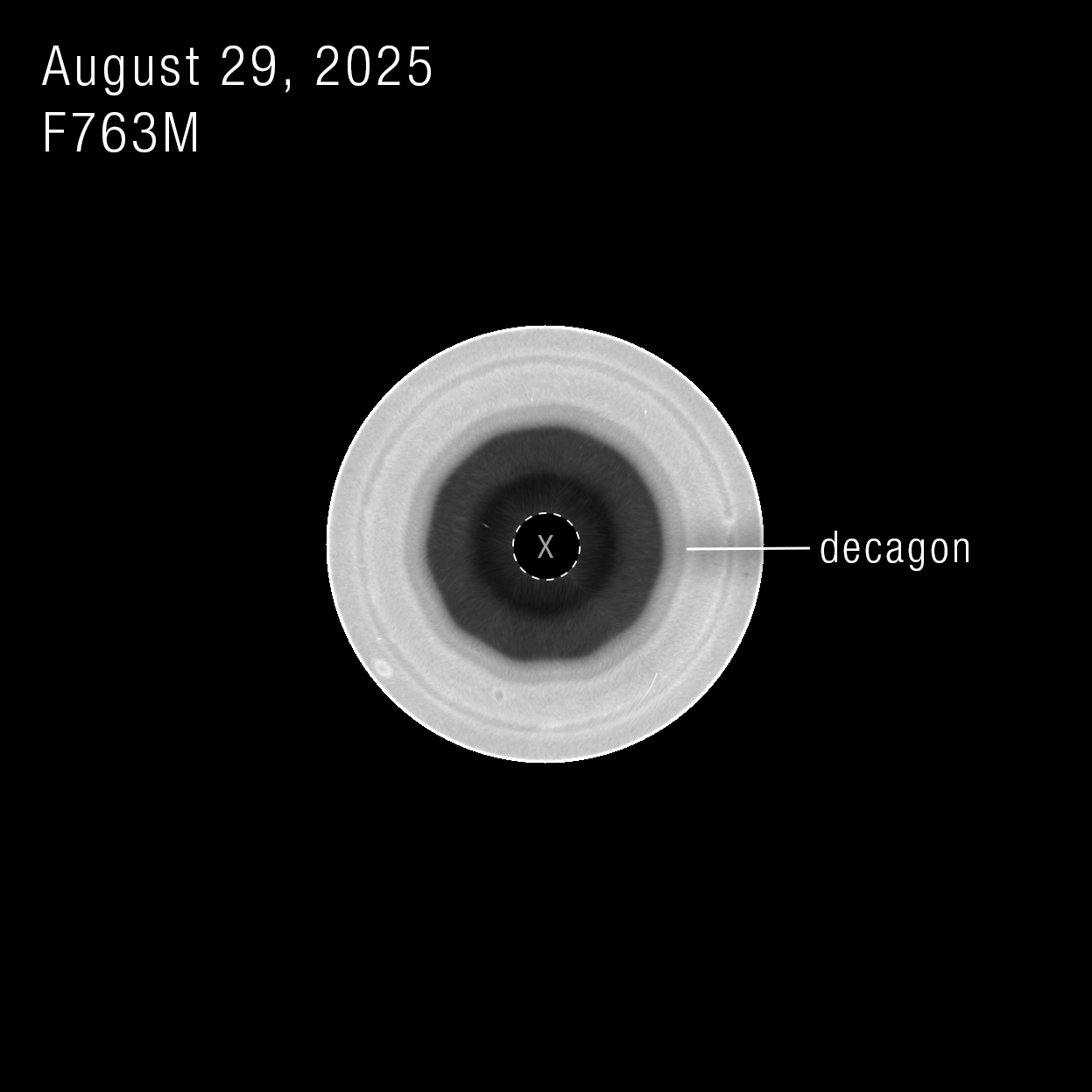
c ≈ U − β / (k² + l²)Why does a single filter reveal the ten sides more clearly?
Hubble's F763M filter enhances contrasts from particular haze and cloud levels, making the boundary easier to trace than in a natural-color portrait. The X is not a mark on Saturn: it identifies a small polar region with no data. Researchers must still determine whether the decagon is shallow or rooted more deeply, and whether it will persist for decades or change with the seasons.
| Layer | What we can say | Boundary we should not cross |
|---|---|---|
| Observation | The southern decagon becomes clearer in 2023–2025 Hubble data; the northern hexagon has been observed for over forty years. | The polygons are neither solid objects nor artificial construction. |
| Physical models | Jet instability, Rossby waves and rotating convection each explain part of the behavior. | Several models do not mean science has failed or that any mystical claim becomes valid. |
| Mathematics | Wave numbers six and ten count repetitions around a circle; symmetry makes complex flow look ordered. | Side counts are not fortune codes, and no equation implies fate or healing. |
| Taiji and Bagua | Rotation, complementarity, center and circular order can frame an aesthetic analogy; eight trigrams arise from 2³ combinations. | Bagua is not an atmospheric model, and six, eight and ten have no demonstrated physical causal link. |
| Orient Qi design | Rings, rhythm, repetition and space can become bead sequences and metal structure. | Value rests on disclosed material, dimensions and craft—not cosmic energy, luck or medical effects. |
Taiji can illuminate relation; it cannot replace fluid equations
Taiji uses interlocking dark and light to express change and mutual dependence; Bagua arranges three binary lines into eight combinations. Saturn's polygons arise from measurable winds, temperatures, latitudes and waves. Both can evoke order emerging from complexity. That is a cultural juxtaposition, not historical transmission or physical proof. Eastern thought is an aesthetic frame here, never a scientific conclusion.
A safe rotating-fluid observation at home
- Add shallow water to a clear round bowl and a small amount of edible glitter or pepper as tracer; avoid chemical dyes.
- Rotate the bowl slowly, let the water approach uniform rotation, then gently nudge near the center with the back of a spoon.
- Film from directly above and watch vortices, bands and ripples change with speed; a home setup will rarely sustain a regular polygon.
- Record what you actually observe rather than calling an accidental shape a Saturn replica; laboratory work controls depth, temperature, boundaries and angular speed.
Three essential questions
Is there a decagonal building on Saturn?
No. The images trace a wavy boundary in an atmospheric jet. Its sides are drawn by cloud and wind, not a solid surface.
Is the decagon completely explained?
No. The study constrains its structure, speeds and evolution and tests routes that can generate it; depth, persistence and seasonal behavior remain open.
Does it prove Taiji or Bagua is a law of the universe?
No. They can form a cultural analogy around rotation and order, but trigrams cannot predict Saturn's wind speed, wave number or lifetime.
Original paper, NASA observations and verification
- Science Advances: original paper on the decagon wave (DOI)
- NASA Hubble: color observation and data notes for Saturn's south-pole decagon
- NASA Hubble: annotated single-filter decagon image
- NASA APOD: overview of the southern decagon and northern hexagon
- EHU: research-team notes on speeds, period and open questions
- NASA Cassini: full view of the north-pole hexagon, PIA17652
- NASA: long-term observations and wave structure of the northern hexagon
- PNAS: numerical model of polygonal jets from deep rotating convection
- NASA: image and media usage guidelines
Bring cosmic order back to tangible design
Orient Qi uses rings, rhythm and Five Elements color as an Eastern design language. A real piece promises only disclosed materials, bead count, dimensions and workmanship. Saturn may inspire form; it supplies no mystical efficacy.